Thursday, February 25, 2016

Chiang Mai's Silver Temple

Text from a tripadvisor review, a link is provided below. I was shock to find little to no information on the web for this impressive temple. The pictures as always are mine.


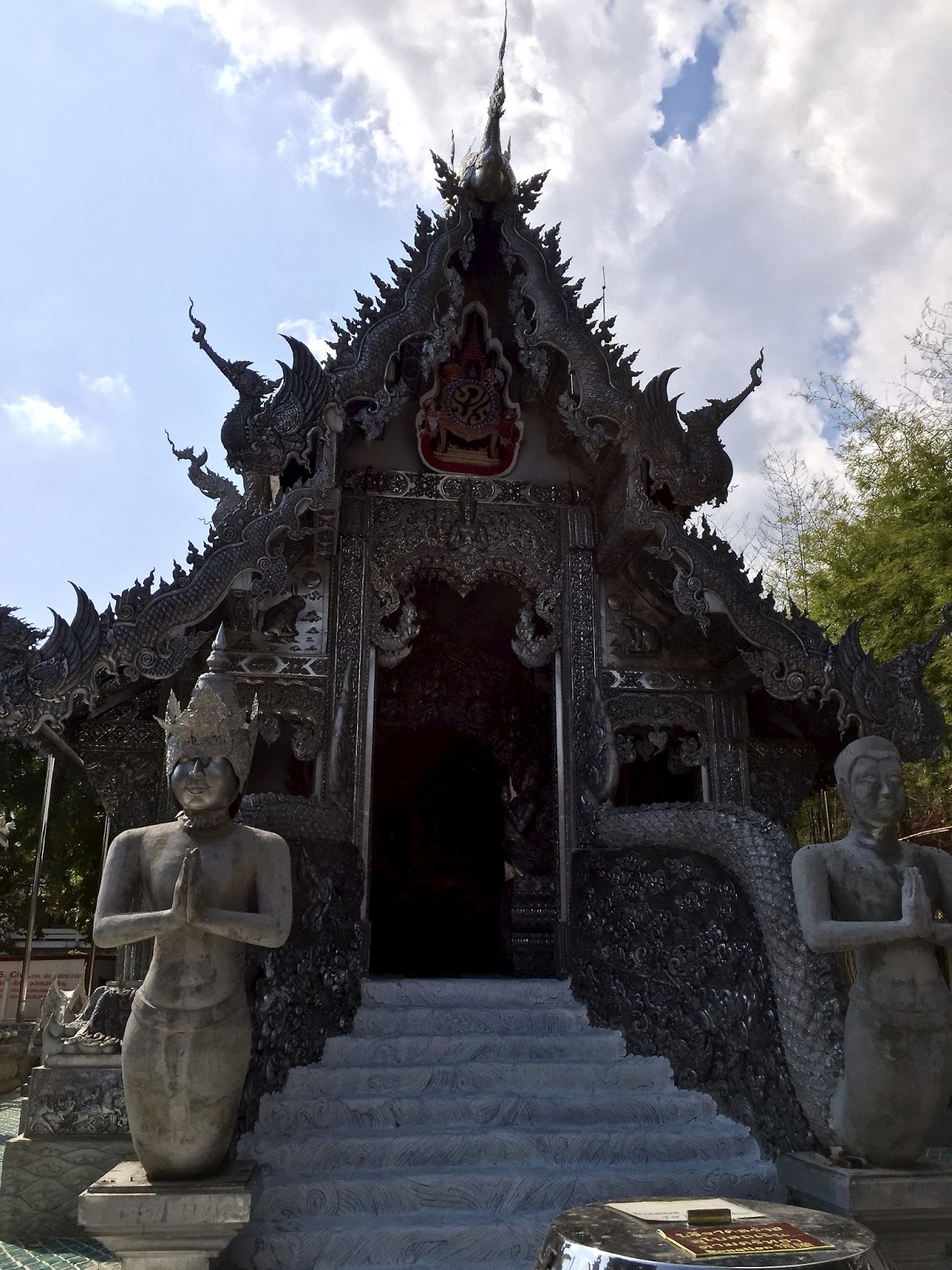


The Sri Suphan temple complex is not visited by many tourists due to its location, just south of the Old City in the traditional silver shops area, in the road in which the Saturday Walking Street market is held, but a trip there is well worth it to see the amazing silver temple.

The highlight of visiting the temple is to see the silver covered ubosot (chapel) on the right hand side as you enter the complex. This is work in progress and the covering of the chapel in silver (actually a mixture of silver and aluminium) is due to be completed in 2015 according to their excellent English website (no longer active). It is very interesting to watch the silversmiths at work – they are truly talented artists.

The intricate silverwork is beautiful and very detailed, so spend some time looking at it up close to see the detailed scenes, especially on the rear of the chapel.

Woman are not allowed to enter the chapel – so luckily my husband took photos so I could see the beautiful interior, and yes lots of silverwork once again.

The rest of the temple complex is worth visiting, especially the main temple for the beautiful interior and the silver workshop to the left as you enter, where you can see the artisans and monks at work creating the silver panels.

There were very few visitors at the temple during our visit, so we basically had the temple complex to our selves and could get some amazing photographs.

The temple has an interesting history and was even used by the Japanese during WW2 as a base camp. The whole history of the temple can be found on their website (non active at the time of this post), with detailed information all in English
The temple also hosts monk chats and meditation classes on certain days.

Just one thing to remember, as with any temple, you need to dress respectfully and you need to remove your shoes before entering the temple.


Sunday, October 4, 2015

Tianjin, China

From the Wiki https://en.m.wikipedia.org/wiki/Tianjin
Tianjin ([tʰjɛ́ntɕín]; Chinese: 天津; Tianjinese: /tʰiɛn˨˩tɕin˨˩/~[tʰjɛ̃̀ɦɪ̀ŋ]; postal: Tientsin) is a metropolis in coastal northeastern China and one of the five national central cities of China, with a total municipal population of 15,200,000. It is governed as one of the four direct-controlled municipalities of the PRC and is thus under direct administration of the central government. Tianjin borders Hebei Province and Beijing Municipality, bounded to the east by the Bohai Gulf portion of the Yellow Sea. Part of the Bohai Economic Rim, it is the largest coastal city in northern China.
In terms of urban population, Tianjin is the fourth largest in China, after Shanghai, Beijing, and Guangzhou. In terms of administrative area population, Tianjin ranks fifth in Mainland China.[2] The walled city of Tianjin was built in 1404. As a treaty port since 1860, Tianjin has been a major seaport and gateway to the nation's capital. During the Boxer Rebellion the city was the seat of the Tianjin Provisional Government. In the period of late Qing dynasty and the Republic of China, Tianjin became one of the largest cities in China.[3] At that time, numerous western-style buildings and mansions were constructed in concessions, many of which are well-preserved today. After the founding of the People's Republic of China, Tianjin suffered a depression due to the policy of the central government and Tangshan earthquake, but recovered from 1990s.[4]Nowadays Tianjin is a dual-core city, with its main urban area (including the old city) located along the Hai River, which connects to the Yellow and Yangtze Rivers via the Grand Canal; and Binhai, a New Area urban core located east of the old city, on the coast of Bohai Sea. As of the end of 2010, around 285 Fortune 500 companies have set up base in Binhai, which is a new growth pole in China and is a hub of advanced industry and financial activity.


The Great Wall of China

The Great Wall of China is a series of fortifications made of stone, brick, tamped earth, wood, and other materials, generally built along an east-to-west line across the historical northern borders of China to protect the Chinese states and empiresagainst the raids and invasions of the various nomadic groups of the Eurasian Steppe. Several walls were being built as early as the 7th century bce; these, later joined together and made bigger and stronger, are now collectively referred to as the Great Wall. Especially famous is the wall built 220–206 bce by Qin Shi Huang, the first Emperor of China. Little of that wall remains. Since then, the Great Wall has on and off been rebuilt, maintained, and enhanced; the majority of the existing wall is from the Ming Dynasty.
Other purposes of the Great Wall have included border controls, allowing the imposition of duties on goods transported along the Silk Road, regulation or encouragement of trade and the control of immigration and emigration. Furthermore, the defensive characteristics of the Great Wall were enhanced by the construction of watch towers, troop barracks, garrison stations, signaling capabilities through the means of smoke or fire, and the fact that the path of the Great Wall also served as a transportation corridor.
The Great Wall stretches from Dandong in the east, to Lop Lake in the west, along an arc that roughly delineates the southern edge of Inner Mongolia. A comprehensive archaeological survey, using advanced technologies, has concluded that the Ming walls measure 8,850 km (5,500 mi). This is made up of 6,259 km (3,889 mi) sections of actual wall, 359 km (223 mi) of trenches and 2,232 km (1,387 mi) of natural defensive barriers such as hills and rivers. Another archaeological survey found that the entire wall with all of its branches measure out to be 21,196 km (13,171 mi)